
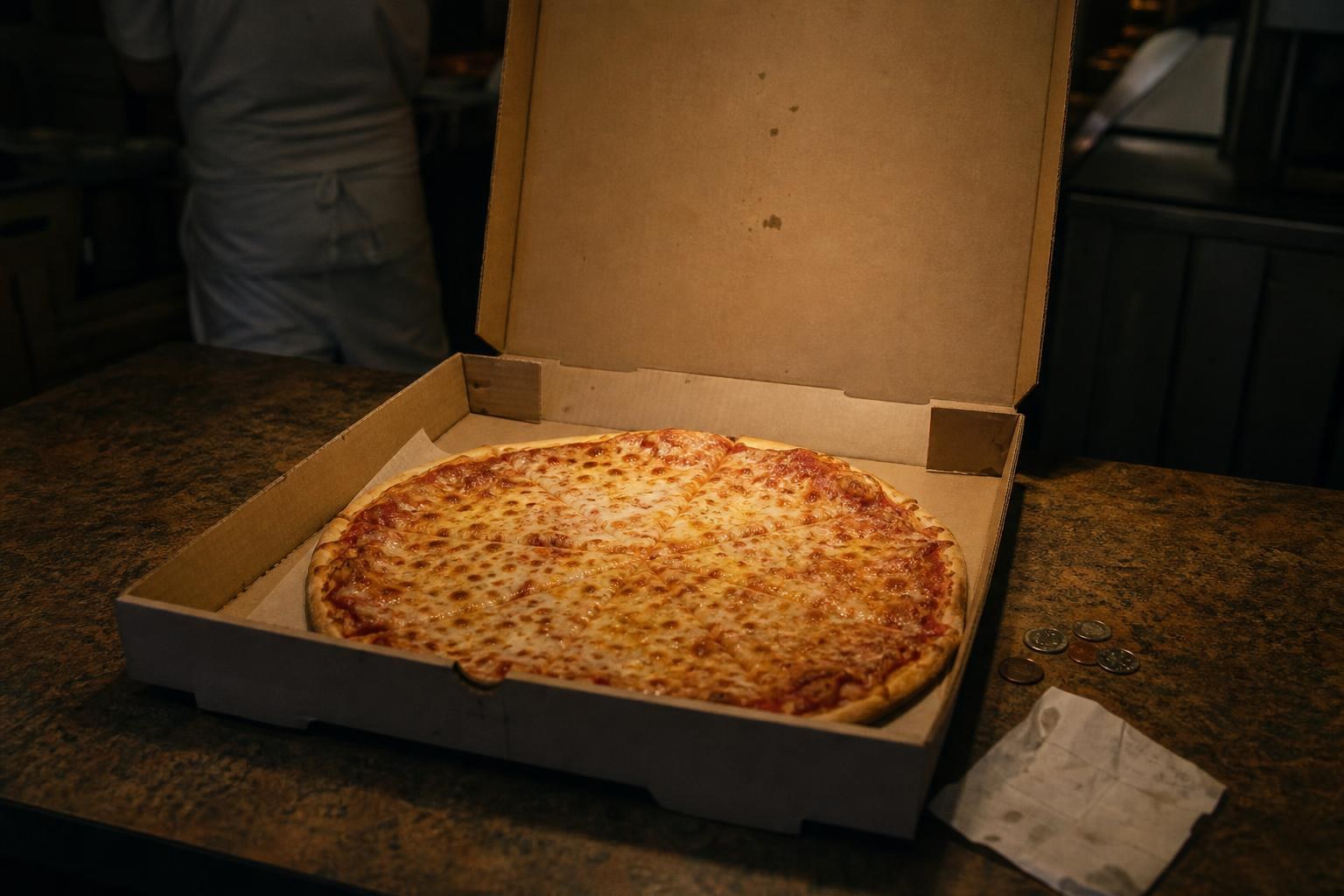
Domino’s is running its self-declared “Best Deal Ever” — any pizza, any crust, any toppings for $9.99 — on top of a standing $6.99 large two-topping carryout special. Pizza Hut answered with a $7 Deal Lover’s menu of 17 items, built to match Domino’s Mix & Match and Papa Johns’ Papa Pairings, both at $6.99. That’s the national price anchor your customers see before they open your menu. The question isn’t whether to match it. It’s how to make sure nobody ever puts your menu next to it.
The deals are getting deeper because they’re not working
Look at what all that discounting actually bought. Domino’s U.S. same-store sales grew just 0.1% in Q2 2026, against 3.4% a year earlier — with franchised stores, 99% of the system, essentially flat even as value promotions ran hard. Pizza Hut fared worse: U.S. system sales fell 5% in the quarter, and Yum agreed to sell the brand to LongRange Capital, with the deal expected to close in August. A year earlier, Pizza Hut’s own leadership blamed an “insufficient value message amid a competitive value landscape” for its slide — and its best-performing promotion was a $2 personal pan pizza that sold out at more than 3,100 stores in a day.
Read that sequence honestly: the deepest discounters in the category are discounting harder every quarter for flat-to-negative comps. That’s not a strategy you copy. That’s a war of attrition between companies with supply chains you’ll never have, and the losing side just got sold.
You’re raising prices into their discounts — and that’s survivable
While the chains cut, you’ve been forced the other way. Limited-service menu prices are up 3.1% year over year, with food-away-from-home up 3.4% — the slowest pace in 17 months, but still an increase, compounding on the increases before it. PMQ’s Pizza Power Report 2026 describes independents raising menu prices and taking the flak from customers while the chains ran their loudest value messaging in years.
The gap between your $18 large and their $6.99 large is real, and it is not closing. Trying to close it is how independents die: you cannot out-discount a company that treats store-level margin as someone else’s problem and makes its money on royalties and dough sales. The only durable answer is to make the comparison itself stop happening.
A customer who compares your pizza to a $6.99 deal isn’t wrong about the math. You let two products that shouldn’t share a category share a description.
The audit: which items invite the comparison, and which escape it
Here’s the uncomfortable exercise. Read your own menu the way a customer holding a Domino’s coupon does. Any item described mostly by size and topping count — “large 2-topping,” “medium 1-topping” — is chain-comparable by construction. Same for generic wings, generic breadsticks, generic 2-liter bundles. Pizza Hut just put breadsticks, wings and dessert bites at $7; if your version reads the same on paper, you’ve priced yourself into their frame at nearly triple the number.
Items escape comparison when the deal can’t describe them. Named pies with a point of view instead of build-your-own grids. A size the chains don’t sell. Dough with a stated fermentation, a cheese with a name, a sauce with a story you can tell in eight words on the menu. Sit-down formats and bundles built around your dining room lean the same way — note that in the same value war, Mountain Mike’s anchored at a $25 family bundle and CPK at $10 with a $20 minimum rather than chasing $6.99. Nobody cross-shops a $25 family night against a coupon code. Visibly not-comparable is a design decision, and it’s cheaper than a discount.
The Weekly
Get the weekly operator brief.
The sharpest pizza-industry intelligence of the week — what changed, why it matters, and what operators should do with it.
Free. One email a week. Unsubscribe anytime — no hard feelings.
The honest limitation: nobody publishes data isolating how much chain discounting actually pulls traffic from independents — the comp data measures the chains against themselves, and PMQ’s operator reporting is directional, not causal. It’s possible the $6.99 customer was never yours to lose. But your menu is the one variable in this fight you fully control, and it costs nothing to find out how much of it is written in the chains’ language.