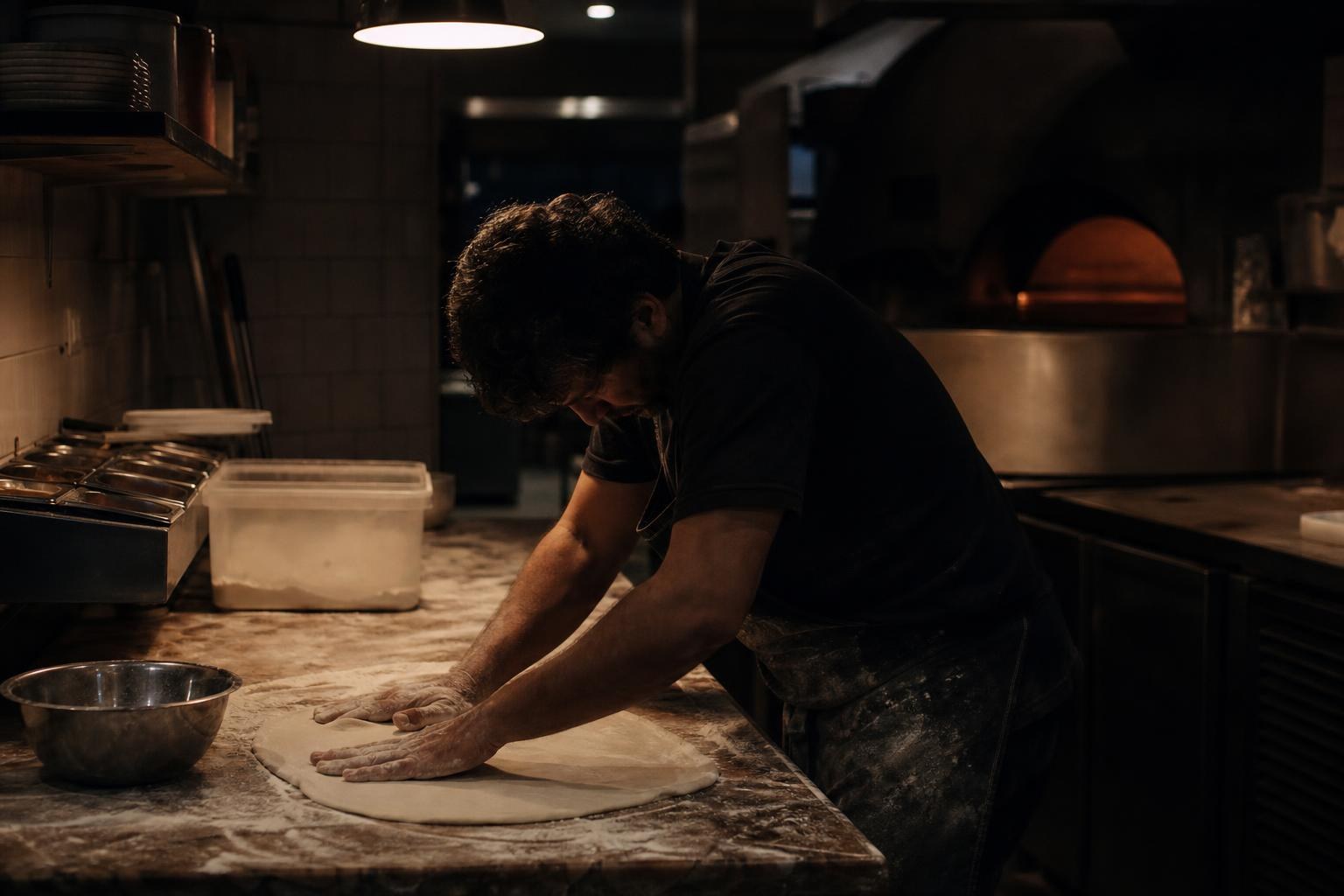

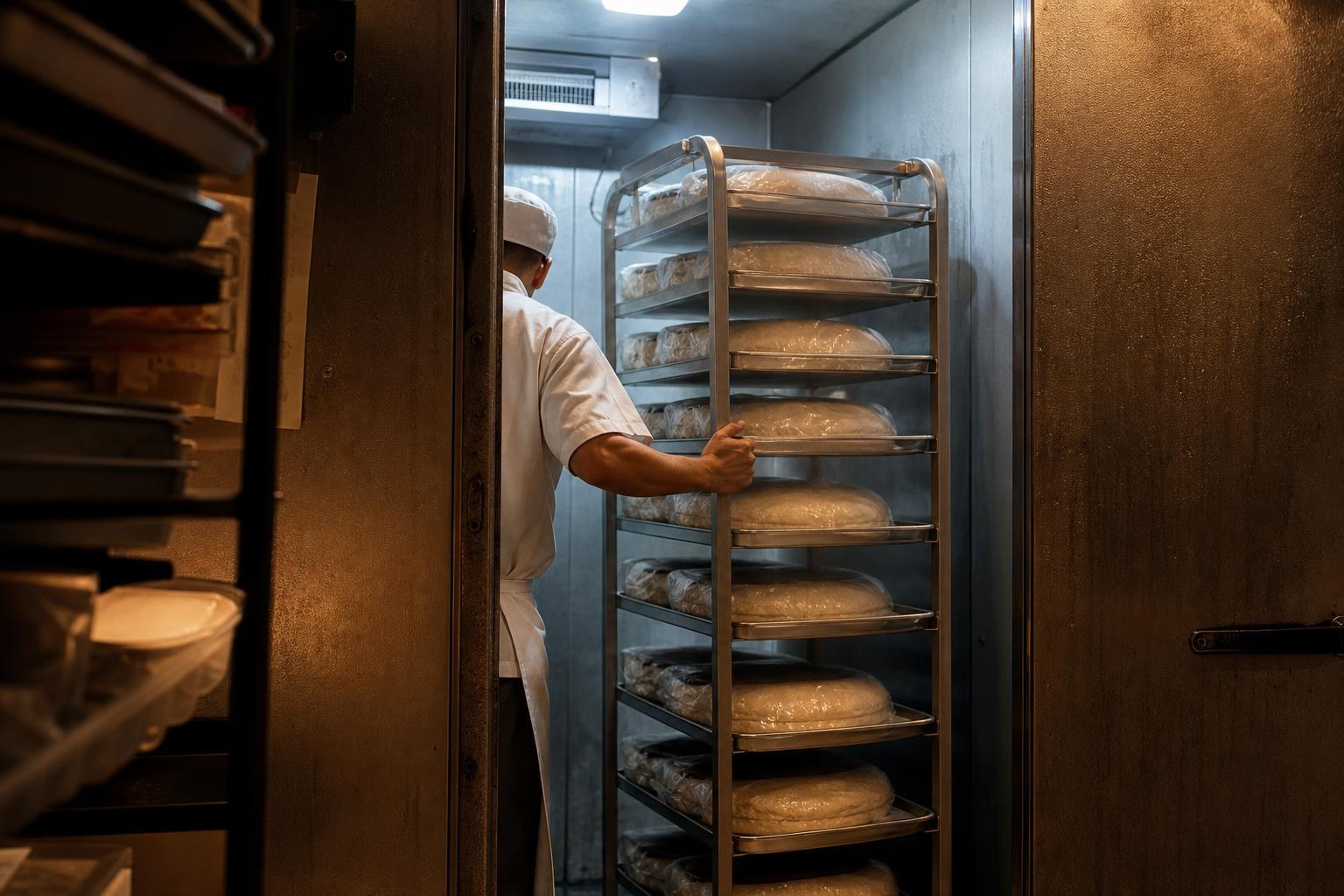
Properly managed dough balls hold in the cooler for up to three days, per the late Tom Lehmann — the American Institute of Baking veteran the trade press called the Dough Doctor. Read that as a technique note and you’ll miss the point. Three days of usable life means dough can stop being a daily emergency and start being inventory. Cold fermentation gets pitched as a flavor move, and it is one. But the operators who run 48- to 72-hour schedules are quietly running a better business, not just a better crust.
Same-day dough is a scheduling problem wearing an apron
A same-day dough program stakes tonight’s service on this morning going perfectly. The mixer person calls out, the walk-in compressor hiccups, a bus tour walks in — and now someone is mixing a panic batch at 4 p.m. that ferments on the rush’s clock instead of the dough’s. Panic batches are where the waste lives: emergency dough that doesn’t proof in time gets forced, and forced dough gets remade or thrown out.
A 48-hour schedule breaks that dependency. Monday’s mix covers Wednesday’s service. Prep becomes a fixed, movable block you can schedule in the dead hours — and if Tuesday goes sideways, Wednesday’s dough is already sleeping in the cooler. You haven’t eliminated variability; you’ve bought two days of slack to absorb it.
The craft benefit rides along for free. Lehmann’s blunt version, from Pizza Today’s dough troubleshooting guide: “fermentation enhances flavor” — time in the cooler is doing flavor work no ingredient can fake. Craft and margin, for once, are pulling the same direction.
The discipline is temperature, and it’s non-negotiable
Cold fermentation only works as a system if the dough actually gets — and stays — cold. Lehmann’s protocol, laid out in PMQ’s dough-management columns, is specific: dough should come off the mixer at 80–85°F and be scaled, balled, boxed and in the cooler within 20 minutes, then cross-stacked until the balls hit 50–55°F internal before the boxes are sealed. Skip the cross-stack and you seal in heat; fermenting dough generates roughly 1°F of its own metabolic heat per hour, which is how a batch “blows” overnight and shows up Wednesday as a box of gassy, unusable balls.
World champion Tony Gemignani makes the same case from the maker’s side: sealing warm dough traps mixer heat and over-ferments the batch, while cross-stacking more than 10–20 minutes starts drying the surface. The window is real on both ends. And on the way out of the cooler, don’t undo the work — Laura Meyer of Pizzeria da Laura notes that “cold dough will not stretch well and will snap back”, so a tempering step at room temperature belongs on the schedule too.
Where the numbers don’t exist — and we won’t invent them
Here’s what we can’t give you: a published benchmark for how much dough waste a cold-ferment schedule saves, or how many labor hours it shifts off the peak. We looked. Neither PMQ nor Pizza Today — nor anyone else we’d trust — has quantified panic-batch waste across shops, and we’re not going to dress up a plausible-sounding percentage as data.
Same-day dough bets tonight’s service on this morning going perfectly. Cold ferment is the same bet with a two-day head start.
What we can say is that the mechanism is technique logic, not speculation: every batch that ferments 48 hours at a stable 36–40°F has had the same thermal history, which is the definition of consistency. Same-day batches ferment at whatever temperature the day handed them. Track your own numbers — dead-count trashed dough balls for two weeks before and after — and you’ll have a better benchmark than the industry currently publishes.
The Weekly
Get the weekly operator brief.
The sharpest pizza-industry intelligence of the week — what changed, why it matters, and what operators should do with it.
Free. One email a week. Unsubscribe anytime — no hard feelings.
The honest limitation: three days of cooler life assumes Lehmann-grade temperature discipline and a cooler that holds 36–40°F under Friday load — an aging walk-in or a cramped reach-in shortens the window, and a high-volume shop may find dough boxes eating shelf space it can’t spare. Cold fermentation doesn’t remove management; it moves the management upstream, where it’s cheaper. Whether your cooler can cash that check is the first thing to test.